Feed 1 part chicken to 2 parts rice; 30–40 g/kg/day, split into 3–4 meals.
Your dog has an upset stomach, and you want to help fast. Chicken and rice is a classic, safe plan that works for many mild tummy troubles. But how much chicken and rice for dog by weight kg should you actually serve? I have seen many pet parents guess, then overfeed. The result can be slow recovery. In this guide, I show simple, vet-informed rules you can use today. I also share balanced dog foods that fit the chicken-and-rice profile for long-term use. Let’s keep things clear, calm, and kind to your dog’s gut.
Blue Buffalo Life Protection Healthy Weight Chicken & Rice

This Blue Buffalo formula targets healthy weight while keeping protein from real chicken at the core. It mirrors the chicken-and-rice style many dogs digest well, but it is fully balanced for daily feeding. I like the moderate calories, the added L-carnitine, and the fiber sources that help satiety. The brand avoids poultry by-product meals and artificial flavors.
LifeSource Bits supply antioxidants and vitamins that homemade chicken and rice will not. That is key if your dog needs to get back to a full diet after a bland-food reset. The kibble size suits most adult dogs. If your dog is prone to weight gain, the calorie control helps you feed to target without guesswork.
Pros:
- Real chicken first for quality protein
- Brown rice and oats for steady energy
- Lower calories to support weight goals
- LifeSource Bits for vitamins, minerals, antioxidants
- No poultry by-product meals or artificial flavors
- Good fiber blend for satiety and stool quality
- Clear feeding chart by weight for easy serving
Cons:
- Not grain-free (a con for dogs needing grain-free)
- Some picky eaters prefer richer formulas
- Bag size (15 lb) may be small for multi-dog homes
My Recommendation
Pick this if your adult dog carries a few extra pounds or gains weight easily. It supports a gentle return to a full diet after a short bland phase. If you ask how much chicken and rice for dog by weight kg for everyday feeding, this bag saves time. The label gives clear daily amounts by weight in kg. It is the balanced version of what your dog’s stomach already knows.
| Best for | Why |
|---|---|
| Overweight or easy-to-gain dogs | Controlled calories and L-carnitine aid weight goals |
| Dogs exiting a bland diet | Chicken and rice profile with full, balanced nutrition |
| Owners who want clear feeding by kg | Feeding chart helps replace “how much chicken and rice for dog by weight kg?” guesswork |
Hill’s Science Diet Perfect Weight Chicken & Rice
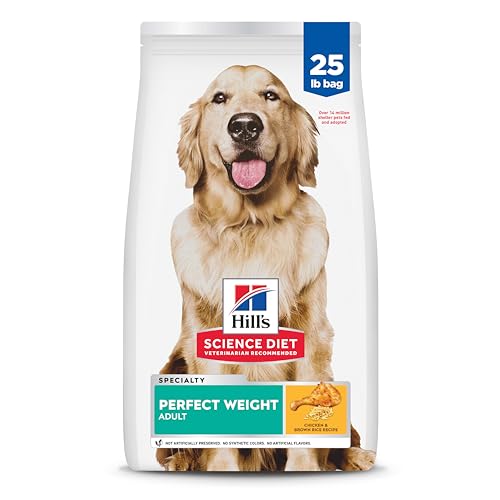
Hill’s Science Diet built this formula from clinical weight research. It aims for steady, safe loss and maintenance in adult dogs. Chicken is the first ingredient, backed by brown rice and other grains for gentle digestion. I like the proven approach and the clear portion guidance by weight.
Many vets recommend Hill’s due to consistent quality control. That helps if you track calories and want repeatable results week to week. The 25 lb bag is cost-effective for medium and large dogs. If your dog struggles with portion control, the feeding chart is a big help.
Pros:
- Clinically tested for weight results
- Real chicken first with a gentle grain blend
- Reliable quality control trusted by many vets
- Clear guidance by weight (kg and lb) on the bag
- Supports lean muscle while trimming fat
- Good choice after bland diet to prevent rebound gain
- Large 25 lb size suits multi-week plans
Cons:
- Some dogs may prefer richer palatability
- Not the cheapest per pound
- Not for puppies or pregnant dogs
My Recommendation
Choose this if you want a vet-trusted, data-backed plan for weight control. It is a fine next step after a short chicken-and-rice reset. For owners asking how much chicken and rice for dog by weight kg on a daily basis, this bag gives exact portions. You get structure, which helps results stick.
| Best for | Why |
|---|---|
| Dogs needing measurable weight loss | Clinically tested portions and predictable results |
| Owners who follow labels | Clear chart replaces “how much chicken and rice for dog by weight kg” math |
| Medium to large adult dogs | 25 lb size, consistent kibble, easy to portion |
How much chicken and rice for dog by weight kg: a complete, simple guide
Chicken and rice is a short-term, bland plan. It helps many mild stomach issues. It should not be a long-term diet. It is not complete. Use it for 1 to 3 days unless a vet says longer. Then go back to a balanced food.
I will keep this simple. I will also give precise steps. You can pick the quick rule or the detailed method. Both work for most adult dogs. Please call your vet if your dog is a puppy, very small, very large, or has a chronic disease.
The quick rule (fast and safe)
Feed total daily amount of the mix at 30–40 grams per kg of body weight. Use a 1:2 ratio by weight: 1 part cooked, skinless chicken to 2 parts cooked white rice. Split into 3–4 small meals per day.
- Example: 10 kg dog → 300–400 g of total mix per day
- Chicken part: 100–133 g/day; Rice part: 200–267 g/day
- Serve 3–4 meals. Keep portions small and even.
This range matches energy needs for rest and gut recovery. It is easy to remember. It is my default for how much chicken and rice for dog by weight kg in the home setting.
The precise method (uses calories)
If you like numbers, use this method. It uses the Resting Energy Requirement (RER). Veterinary nutrition texts define RER as: RER = 70 × (body weight in kg)^0.75.
- Step 1: Find your dog’s weight in kilograms.
- Step 2: Calculate RER = 70 × kg^0.75.
- Step 3: Target 1.0–1.2 × RER for a bland diet, short term.
- Step 4: Use a 1:2 chicken-to-rice mix by weight.
- Step 5: Calories per 100 g of this mix ≈ 142 kcal (lean chicken ~165 kcal/100 g; cooked white rice ~130 kcal/100 g).
- Step 6: Total grams per day = target calories ÷ 1.42.
- Step 7: Chicken grams = total × 0.33; Rice grams = total × 0.67.
Example: 10 kg dog. RER ≈ 70 × 10^0.75 ≈ 70 × 5.62 ≈ 393 kcal/day. Target 1.1 × RER ≈ 432 kcal/day. Daily grams ≈ 432 ÷ 1.42 ≈ 304 g. Chicken ≈ 100 g; Rice ≈ 204 g. Serve in 3–4 meals.
Quick chart: daily amounts by weight (1:2 chicken-to-rice, grams)
This chart uses the quick rule at 35 g/kg/day as a middle target. It is a simple, direct way to plan how much chicken and rice for dog by weight kg.
- 2 kg dog: 70 g total (≈ 23 g chicken + 47 g rice)
- 5 kg dog: 175 g total (≈ 58 g chicken + 117 g rice)
- 7.5 kg dog: 263 g total (≈ 88 g chicken + 175 g rice)
- 10 kg dog: 350 g total (≈ 117 g chicken + 233 g rice)
- 15 kg dog: 525 g total (≈ 175 g chicken + 350 g rice)
- 20 kg dog: 700 g total (≈ 233 g chicken + 467 g rice)
- 25 kg dog: 875 g total (≈ 292 g chicken + 583 g rice)
- 30 kg dog: 1050 g total (≈ 350 g chicken + 700 g rice)
- 35 kg dog: 1225 g total (≈ 408 g chicken + 817 g rice)
- 40 kg dog: 1400 g total (≈ 467 g chicken + 933 g rice)
Start at the middle target. Adjust up or down within 30–40 g/kg/day based on your dog’s body condition and stool.
How to cook the bland diet right
Use skinless, boneless chicken breast or very lean thigh. Boil or poach in plain water. Do not add oil, butter, or spices. Shred the chicken into small pieces.
Cook plain white rice in water. Do not add salt or broth. White rice is easier on the gut than brown in most cases. Mix 1 part chicken to 2 parts rice by weight. Cool the mix before serving.
How long to feed chicken and rice
Most dogs need 24 to 72 hours on a bland diet. Start with small, frequent meals. Watch stool and energy. If you see blood, pain, or vomiting, stop and call your vet.
After stools improve, begin a slow transition back to your regular dog food over 3 to 5 days. Mix in 25% regular food on day one, then 50%, then 75%, then 100%. Use the bag’s feeding chart. This replaces the daily question of how much chicken and rice for dog by weight kg.
Portioning tips for how much chicken and rice for dog by weight kg
- Split the daily total into 3–4 meals.
- If stools are still loose, feed the lower end of the range (30 g/kg/day).
- If your dog is lean and hungry, try the higher end (40 g/kg/day).
- Add a spoon of water to each meal to boost hydration.
When to use white rice vs brown rice
White rice is best for mild diarrhea or a sudden upset. It is simple and easy to digest. Brown rice has more fiber and nutrients. It can be harder on an irritated gut. Use brown rice only after the gut calms or if your vet suggests it.
For daily feeding, pick a balanced chicken-and-rice kibble. The two reviewed options are good places to start. They remove the guesswork from how much chicken and rice for dog by weight kg and add full nutrients.
What about puppies?
Puppies have higher energy needs. They also need balanced minerals for growth. Do not keep a puppy on a bland diet for long. Call your vet if a puppy has GI issues.
If your vet approves a short bland period, aim for the higher end of 35–45 g/kg/day, split into 4–6 meals. Return to a puppy formula as soon as possible. Track hydration closely.
Large breeds and seniors
Large breeds can have sensitive joints and slower guts. Seniors may have slower digestion too. For both, use the lower end of the range. Start at 30–33 g/kg/day. Watch comfort and stool. Keep meals small and frequent.
Lean dogs vs overweight dogs
Lean or underweight dogs may need a bit more. Try 38–40 g/kg/day for a day or two. Overweight dogs do better at 30–33 g/kg/day. The goal is gut rest, not weight gain. Keep treats off the menu until stools normalize.
Signs you are feeding the right amount
- Stool firms up within 24–72 hours
- Energy is stable or improves
- No vomiting or abdominal pain
- No bloating or straining
If any warning signs appear, stop and call your vet. That matters more than any rule about how much chicken and rice for dog by weight kg.
Protein and fat notes
Use lean chicken. Trim visible fat. Avoid skin. Too much fat can trigger or worsen pancreatitis in sensitive dogs. Keep things plain. Save oils for later, once the gut is stable.
Extras you can add (vet-approved)
- Plain canned pumpkin (1 tsp per 5 kg) for fiber
- Canine probiotics as directed on label
- Water or an oral rehydration solution for pets, if advised
Do not add dairy, butter, or spices. Keep it clean and simple for recovery.
Storage and food safety
Cook enough for 24–48 hours. Refrigerate portions in sealed containers. You can freeze single-meal packs for later use. Warm to room temperature before serving, but do not use grease.
Transitioning back to balanced food
Once stools improve, begin the switch. Use a 4-day plan: 75% bland and 25% regular on day 1. Then 50/50 on day 2. Then 25/75 on day 3. Day 4 is 100% regular. If stool loosens, step back a day.
If you prefer a chicken-and-rice style, consider a balanced kibble. It solves how much chicken and rice for dog by weight kg long term. The bag chart does the math, and the food is complete.
Sample daily plans by weight (1:2 chicken:rice)
These are sample totals for one day, split into 3–4 meals. Use them as a starting point.
- 5 kg dog (30–40 g/kg/day): 150–200 g total. Chicken 50–67 g; Rice 100–133 g.
- 10 kg dog: 300–400 g total. Chicken 100–133 g; Rice 200–267 g.
- 15 kg dog: 450–600 g total. Chicken 150–200 g; Rice 300–400 g.
- 20 kg dog: 600–800 g total. Chicken 200–267 g; Rice 400–533 g.
- 30 kg dog: 900–1200 g total. Chicken 300–400 g; Rice 600–800 g.
Adjust based on stool and comfort. Your dog’s needs can vary by age, health, and activity.
Why 1:2 chicken to rice?
This ratio gives easy carbs for the gut and lean protein for repair. It also keeps fat low. That is key in many upset stomach cases. Some dogs do well on 1:1 by weight. I still suggest 1:2 to start. It is safer for most mild GI flares.
White rice, jasmine, or basmati?
All three can work. Choose plain, well-cooked white rice. The goal is soft, simple starch. Rinse rice before cooking to remove extra starch. That can help reduce gas for some dogs.
Seasoning and broth?
Avoid broth unless it is free of onions, garlic, and fat. Many store broths contain onion or garlic. These are unsafe for dogs. Salt is not needed. Keep it plain and safe.
How to measure grams without a scale
A kitchen scale is best. If you do not have one, use volume as a rough guide. One cup of shredded cooked chicken is about 140 g. One cup of cooked white rice is about 150–160 g. This is only a rough estimate.
Example: For a 10 kg dog at 350 g/day total, you need about 2.2–2.4 cups total mix per day. That is about 0.8–1 cup chicken and 1.5–1.6 cups rice. Split into 3–4 meals.
Hydration matters
Offer fresh water at all times. Add a bit of warm water to each meal. It helps digestion. If your dog is not drinking, call your vet. Dehydration can turn mild issues into urgent ones.
How long is too long?
Do not feed the bland diet for more than 3 days unless your vet directs it. It lacks key nutrients. Long-term use can cause problems. After symptoms settle, return to a balanced food. Use the bag’s chart so you do not have to ask how much chicken and rice for dog by weight kg every day.
When to call the vet now
- Blood in stool or black stool
- Repeated vomiting
- Severe pain, fever, or bloating
- Puppy or senior showing fast decline
- Symptoms last beyond 48–72 hours
These signs need expert care. Do not wait.
What about using brown rice long term?
Brown rice is fine in balanced foods. It has fiber and nutrients. Many top kibbles blend chicken and brown rice. They are designed to be complete. They also include the feeding chart you need.
Both products in this review help you avoid daily math. They make how much chicken and rice for dog by weight kg simple again. Follow the label. Watch your dog’s body and stool.
How I decide the right end of the range
I use 30–33 g/kg/day for overweight, low-activity, or large breeds. I use 33–36 g/kg/day for average adult dogs. I use 38–40 g/kg/day for lean, active, or slightly underweight dogs.
This simple range is easy to remember. It covers most cases for how much chicken and rice for dog by weight kg at home.
Portion frequency and timing
Feed every 4–6 hours at first. Small, even meals reduce gut load. Dogs rest better with steady intake. Night meals are fine if that suits your routine. Keep stress low and walks calm.
FAQs Of how much chicken and rice for dog by weight kg
How much chicken and rice for dog by weight kg for a 10 kg adult?
About 300–400 g total per day using a 1:2 ratio. That is 100–133 g chicken and 200–267 g rice, split into 3–4 meals.
Should I use white rice or brown rice for diarrhea?
Use white rice. It is easier to digest. Brown rice is better when your dog is stable or in balanced kibble.
How long can I feed the bland diet?
Usually 1–3 days. If symptoms persist or worsen, call your vet. Do not use long term without vet advice.
Can I add broth or seasoning?
No. Keep it plain. Avoid onions, garlic, fat, and salt. Use water to moisten if needed.
What if my dog is overweight?
Use the low end, 30–33 g/kg/day. Split into small meals. Switch back to a weight-control kibble once stools improve.
Final Verdict: Which Should You Buy?
For simple portion control after a bland diet, both bags work. Blue Buffalo fits gentle weight support with a familiar chicken-and-rice feel. Hill’s Science Diet adds clinical weight results and very clear guidance.
If you often ask how much chicken and rice for dog by weight kg, pick the bag with the chart you trust most. I lean Hill’s for structure. I lean Blue Buffalo for flavor and value.